
Observations on the Zoology of the Galapagos Archipelago
Abstract
Between the 15th of September and the 20th of October 1835, H.M.S. Beagle visited the Galapagos Archipelago, where observations were made on the geology, climate, and natural history of the islands. The present account summarises the zoological specimens collected and the geological features surveyed, with particular attention to the remarkable endemism of the terrestrial fauna — most notably the giant tortoises and the small land-birds of the finch-family, whose variation by island appears to be more than accidental.
Approach to the Archipelago
On the 15th of September 1835, the Beagle drew within sight of Mount Pitt, the highest land of Chatham Island, rising indistinctly through a heavy morning haze. For five weeks thereafter the ship would work through the archipelago, anchoring at a succession of islands whose character proved as diverse as their appearance suggested from the sea.
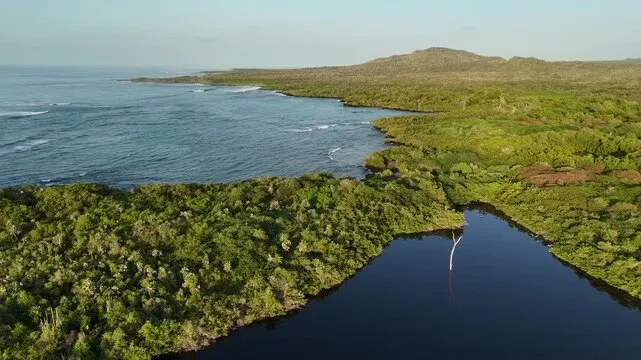
The volcanic origin of the chain is evident at first approach. Each island is a single cone, or a group of cones, built of basaltic lava. The older islands, to the east, have been deeply weathered; those to the west retain the sharp scarps and fresh craters of recent activity. From the ship's boat the shore everywhere presents a forbidding aspect: black reefs of scoriaceous rock, beaten by a heavy surf, and backed by low thickets of leafless shrubs.
The following provisions and instruments were aboard for the duration of the survey:
The islands by first impression
Four of the larger islands — Chatham, Charles, Albemarle, and James — were visited in succession. Each had its own particular fauna, which became apparent from the very first landing. Don Harris, the Vice-Governor, observed in conversation that he could tell from which island a tortoise had been brought by the form of its shell alone — a remark that took on, in retrospect, a considerable scientific weight.
On the climate
The prevailing wind at the time of the visit was the south-east trade; a steady but not violent breeze which cooled the air materially. Though the archipelago sits almost on the equator, the temperature never exceeded 29 °C during daylight, and the nights were comfortably cool. Rain was rare — the islands evidently lying too low to intercept the higher cloud layer.
Salt pork and hardtack sufficient for a month at sea.
Charts after Colnett (1798) and the Spanish survey of 1790.
Barometers calibrated at Callao, Peru.
A theodolite, two sextants, and the ship's chronometer.
Zoological observations
The zoology of the archipelago is at once striking and peculiar. Of the several hundred species seen during the visit, almost all are endemic — that is to say, they occur nowhere else. The resemblance of the fauna to that of the South American continent, rather than to that of any other equatorial region, is the more noteworthy given that the nearest land lies some six hundred miles to the east.
Giant tortoises (Testudo elephantopus)
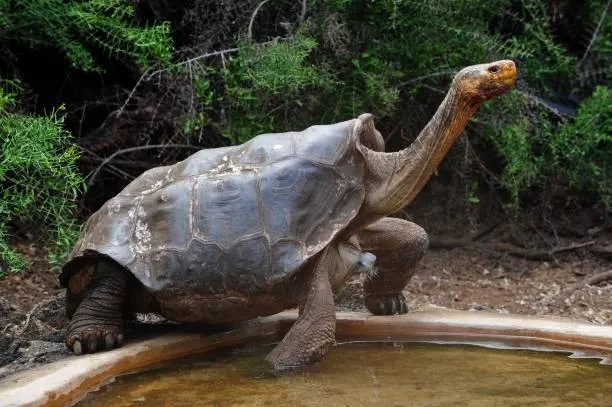
The giant tortoises were the most conspicuous of the native quadrupeds. Several hundred were observed at close quarters, and a number brought aboard for later dissection. The animals were encountered in greatest numbers on Isabela (Albemarle) and Santa Cruz (Indefatigable). Two distinct forms were remarked: a domed variety confined to the wetter, higher islands, and a saddleback form restricted to the drier, lower ones.
The saddleback carapace is high over the neck and deeply notched, permitting the animal to raise its head much higher than the domed form can — an advantage, plainly, on islands where the chief vegetation is the tall Opuntia cactus. Where the Opuntia grows low and sprawling, the tortoises are domed; where it grows as tall erect trees, they are saddlebacked. Whether this association is one of cause or of common adaptation to climate the observations do not decide.
The finches (Geospizinae)
No group is more remarkable than the thirteen species of small land-birds of the finch kind. All are of sombre plumage — the males somewhat darker than the females — and all share the same general habit and call. Yet their beaks vary to a degree quite unaccounted for in any single island's circumstances. One may find, within the space of a single morning's walk on Santa Cruz, four or five species whose beaks differ in depth from four millimetres to nearly twenty.
The variation is graded; the species shade into one another in a way that renders a sharp classification difficult. The stoutest-beaked birds feed on the hardest seeds of the Opuntia and the Palo Santo; the slenderest probe the flowers of Bursera for insects. Intermediate beaks exploit intermediate foods. It is as though a single ancestral stock had been modified in different directions according to the food each population happened to find available.
Marine iguana (Amblyrhynchus cristatus)
A large black lizard, from two to four feet in length, inhabits every rocky shore of the archipelago. Unlike any other of its genus it is an exclusively marine feeder, diving into the sea to crop the short green algae that carpet the submerged rocks. It is, so far as I am aware, the only lizard known to feed habitually in the sea.
The animal swims well, propelled by lateral undulations of its flattened tail; the legs are held close against the body. On land it is sluggish and curiously reluctant to enter the water, even when pursued — a reluctance that may be explained by the abundance of sharks in the surrounding shallows.
Tortoise specimens collected
The following specimens of Chelonoidis were secured at five islands for later study in England. Each animal was measured before stowage and its carapace sketched from above and in profile; the sketches are reproduced in Plate VII of the Zoology of the Voyage of H.M.S. Beagle (1839). Particular attention was given to the degree of carapace elevation over the neck, since the variation by island appears to be systematic.
Island
Species
Count
Notes
Española
Chelonoidis hoodensis
3
Saddleback carapace; long upraised neck.
Isabela
Chelonoidis guntheri
2
Domed form; collected on the slopes of Volcán Wolf.
Santa Cruz
Chelonoidis porteri
4
Intermediate carapace; the most numerous form seen.
San Cristóbal
Chelonoidis chathamensis
2
Modified saddleback; a larger body than the Española form.
Pinzón
Chelonoidis duncanensis
1
Small population; juvenile.
Total
12
Finch beak morphometrics
Beak depth and length were measured with vernier callipers for each captured bird, to the nearest tenth of a millimetre. The specimens were subsequently lodged at the Zoological Society of London; the averages reported below are taken from the pooled measurements of a single island's population. Even at this small sample, the separation of the species by beak dimensions is clear, and correlates closely with observed differences in diet.
Species
Island
Beak depth
Beak length
n
Geospiza magnirostris
Floreana
19.4
16.2
5
Geospiza fortis
Santa Cruz
12.1
11.4
8
Geospiza fuliginosa
Isabela
8.3
8.9
12
Camarhynchus psittacula
Santa Cruz
9.8
10.7
4
Certhidea olivacea
Santiago
4.6
7.1
6
Geospiza scandens
Floreana
8.1
13.5
3
Measurements in millimetres; n indicates the number of specimens averaged.
A note on biogeography
The facts recounted in the preceding chapters bear directly on the question of how the terrestrial fauna of oceanic islands is to be accounted for. Taken together, several observations point to a common conclusion.
That conclusion appears to me far-reaching; but I set it down here as a provisional one, to be tested against the specimens and notes as they are worked over in England, and against whatever further travels may furnish.
The terrestrial fauna of each island, though composed largely of the same generic types, is in almost every case specifically distinct from that of its neighbours. This is most marked in the tortoises, the mocking-birds (Mimus), and the finches (Geospiza and its allies).
The resemblance of the fauna as a whole is to that of the American continent to the east, and not to that of any other equatorial archipelago — neither the Cape Verdes, which resemble in geology and climate, nor the Seychelles.
Endemic forms display gradations between island populations that approach, at the extreme, the differences between what systematists have called separate species. Whether the interval is properly specific, or whether the populations are varieties of a single species in the act of dividing, is a question the present observations leave open.
The colonisation of the islands, evidently, must have occurred by sea from the continent. The birds and the land-tortoises alike — the latter tolerant of prolonged immersion in sea-water, as I have verified — could have reached the archipelago by this means. Once established, the populations have been subject to conditions unlike those of their origin.
The conclusions that appear to me most probable are these: that each of the endemic species is descended from some continental ancestor; that separation between islands has prevented the inter-breeding which would else have kept them uniform; and that, by differences in food and in habit, the populations have diverged, each adapting to the particular economy of its island home.
Plates
References
Loading references…